
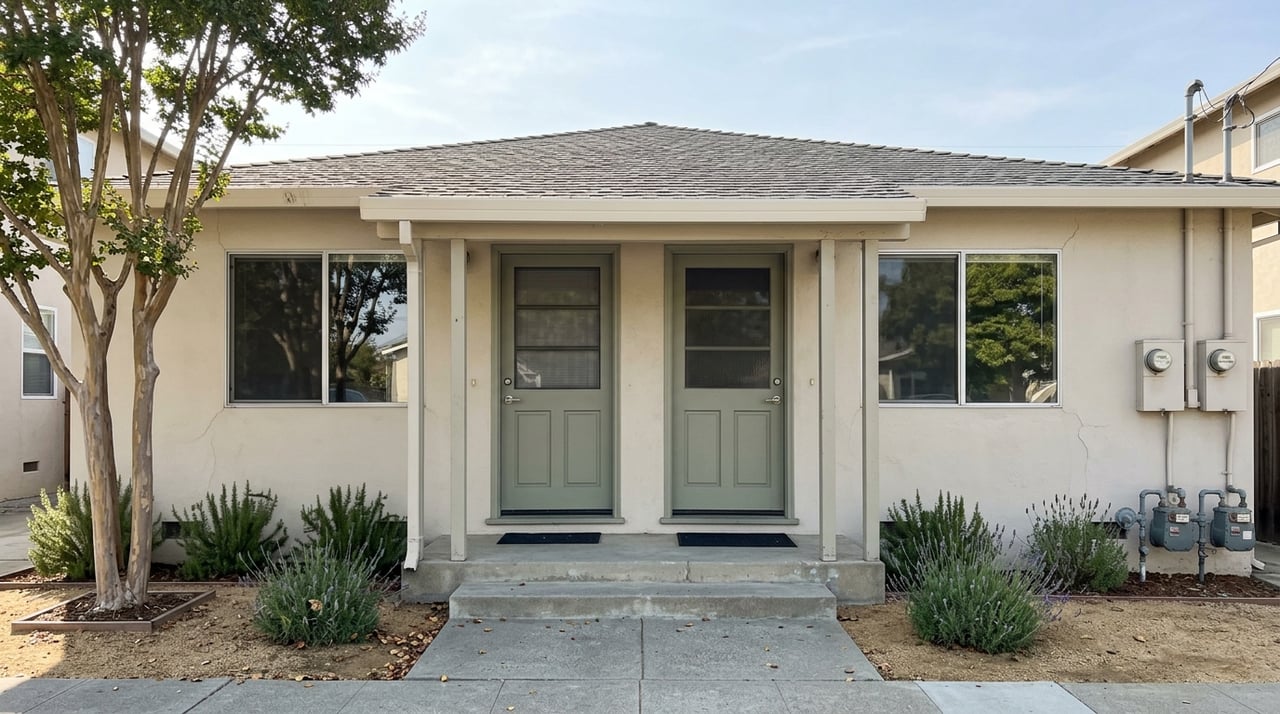
Thinking about buying your first duplex in Mendota after owning or investing in a single-family home? That next step can open new income possibilities, but it also comes with a different set of numbers, property standards, and financing rules. If you want to scale carefully and stay grounded in local reality, this guide will show you what changes, what to watch, and why Mendota can be a practical market to explore. Let’s dive in.
Mendota stands out as a lower-cost housing market when compared with Fresno County overall. The U.S. Census Bureau QuickFacts for Mendota reports a median owner value of $250,400 and median gross rent of $874, while Fresno County shows a median owner value of $388,800 and median gross rent of $1,392.
That difference matters when you are moving from a single-family property into a duplex. A lower entry point can make it easier to test your underwriting, preserve cash reserves, and learn small multifamily ownership without jumping into a much more expensive market.
Mendota also has a meaningful renter base. According to the city’s Housing Element, 52.5% of households are renters, which supports the idea that rental housing is an active part of the local market.
If you are worried that duplexes are rare or hard to place in Mendota, the local housing data suggests otherwise. The city’s Housing Element says duplex, triplex, and fourplex properties make up about 17.8% of the city’s housing units.
That is helpful for investors because it means small multifamily housing is already part of the existing inventory. You are not stepping into a product type that feels out of place in the market.
The same document explains that Mendota’s R-2 and R-3 zoning districts can accommodate duplexes and other small multifamily formats. In practical terms, that gives you a clearer framework for where this type of property may fit, though you should always verify current zoning and use details with the city before making an offer.
The biggest mistake buyers make when moving from a single-family home to a duplex is assuming the process works the same way. It does not.
With a duplex, lenders and appraisers usually look more closely at income, expenses, and the property’s ability to perform as a rental asset. Even if the building feels similar in size to a house, the underwriting is often more detailed.
Here are the main shifts you should expect:
If you plan to live in one unit and rent the other, a duplex may open financing paths that many buyers do not realize are available. HUD states that FHA-insured mortgages can be used for 2-4-unit properties, and that the minimum required investment is 3.5% in most cases.
That does not mean every buyer will qualify, but it does show why some owner-occupants use a duplex to move from single-family ownership into small multifamily. Living in one unit while renting the other can change the math and the financing conversation.
If you are buying strictly as an investment, the lender may look at the file differently. Fannie Mae’s rental income guidance shows that rent can be counted based on factors like whether the property is a 2-4 unit principal residence or a one- to four-unit investment property, and whether the lender is relying on leases, tax returns, or rental forms.
That means your paperwork matters more than it might on a standard single-family purchase. Clean leases, a realistic income picture, and strong documentation can make a real difference.
A duplex appraisal is not just a bigger version of a single-family appraisal. Fannie Mae says the income approach is required in the valuation of two- to four-unit properties.
In plain language, the appraiser is not only looking at comparable sales. They are also considering the property as an income-producing asset.
That can affect value expectations, especially if the units need repairs, have below-market rents, or show inconsistent occupancy history. If you are scaling up, it helps to prepare for a valuation process that looks at both property condition and income potential.
Before you move from a single-family property to a duplex, get comfortable with a few rental-property basics. You do not need to become a full-time analyst, but you do need to understand how lenders and investors think.
Key terms include:
Freddie Mac’s glossary defines debt coverage ratio this way and also explains that effective gross income reflects rent and other allowable income after vacancy, concessions, and bad debt allowances.
That is why conservative assumptions matter. A duplex can reduce risk compared with a single rental because one vacant unit does not always mean zero income, but it is still smart to underwrite with room for vacancy rather than assuming both units will always stay occupied.
One of the most important local factors in Mendota is age of inventory. The city’s Housing Element reports that 50.8% of the housing stock is more than 30 years old, and 19.2% is more than 50 years old.
For a duplex buyer, that should shape your inspection strategy and your reserve planning. Older properties can still be strong investments, but only if you budget for repairs before they become emergencies.
Freddie Mac defines deferred maintenance as postponed normal maintenance that can lead to deterioration or reduced property value. That is especially relevant in a market with older housing stock, where smaller issues can build into larger capital needs.
If you are scaling up in Mendota, use a checklist that goes beyond the usual single-family walk-through. Look at the property as both a home and a small business asset.
Focus on these areas:
You should also keep replacement reserves in mind. Freddie Mac’s multifamily underwriting overview notes that replacement reserves are typically required in multifamily underwriting models, which is a useful reminder that long-term upkeep should be part of your numbers from day one.
The right duplex path often comes down to how you plan to use the property. If you intend to live in one unit, you may have more financing flexibility and a more manageable way to learn rental ownership.
If you plan to buy purely for investment, expect more focus on reserves, rental income history, and operating performance. Freddie Mac notes that investment properties can involve added requirements around reserves, housing expense ratios, and rental income review, which helps explain why this route can feel more documentation-heavy.
Here is a simple way to compare the two approaches:
| Strategy | Main Advantage | Main Challenge |
|---|---|---|
| Live in one unit | May offer more accessible financing options | You become both resident and landlord |
| Buy as an investment | Full rental income potential from both units | Usually more underwriting scrutiny |
Neither option is automatically better. The right fit depends on your budget, your tolerance for hands-on management, and how quickly you want the property to perform.
Moving from a single-family property to a duplex is not just about buying one more door. It is about learning to analyze cash flow, condition, financing, and risk in a more disciplined way.
In Mendota, that step can make sense because duplexes already exist within the local housing mix, the market remains relatively lower cost compared with Fresno County, and the renter share supports the role of rental housing. At the same time, older housing stock means you need to stay careful about inspections, reserves, and deferred maintenance.
If you want help evaluating a duplex opportunity in Mendota, working through financing options, or comparing a single-family rental against a small multifamily purchase, Boyd Realtors offers practical local guidance backed by Central Valley market knowledge and full-service support.

We pride ourselves in providing personalized solutions that bring our clients closer to their dream properties and enhance their long-term wealth. Contact us today to find out how we can be of assistance to you!

BRIAN ELLSWORTH | CA DRE# 01230440
CHERIE SMITH | CA DRE# 01442806
KEN BOYD | CA DRE# 00323505
[email protected]
275 S Madera Ave Ste 100
Kerman CA 93630
CA DRE# 02127943 | NMLS# 2109517
8AM-5PM MONDAY-FRIDAY and by appointment