
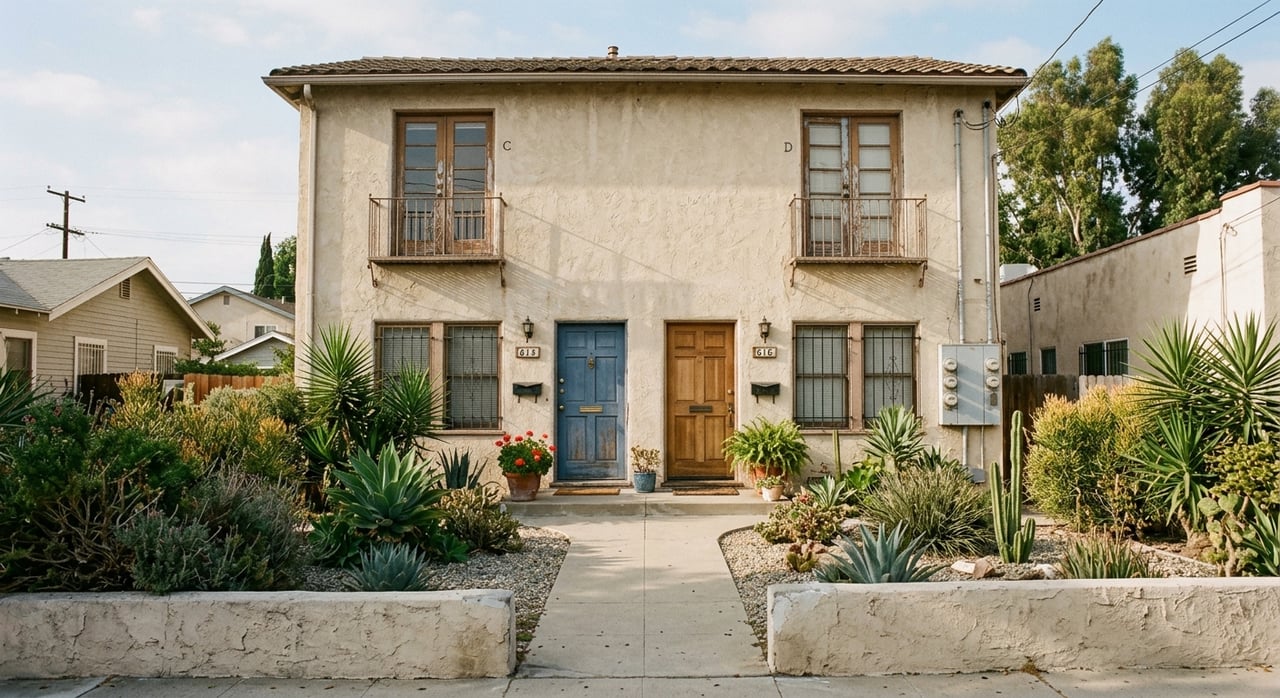
If you have been thinking about buying your first investment property, a small multi-unit in Fresno can be one of the most practical ways to start. You may want rental income, a path into house hacking, or a property that feels more manageable than a larger apartment building. The good news is that Fresno gives you a real rental market to study, but the numbers only work when you look closely at rents, expenses, and local rules. Let’s dive in.
Fresno is not a tiny rental niche. The City of Fresno has 555,549 residents, and the city’s adopted 2024 housing element reports 170,137 households, including 90,440 renter-occupied households, or 53.2% of all households. That tells you rental housing is a major part of the local market, which matters when you are evaluating duplexes, triplexes, and fourplexes.
The city’s housing profile also gives helpful context for entry-level investors. Census QuickFacts lists a median gross rent of $1,421 and a median owner-occupied housing value of $374,800. Those figures do not price a specific property for you, but they help frame Fresno as a market where both rental demand and owner housing costs deserve close attention.
For most first-time investors, a small multi-unit means a property with two to four residential units. That usually includes duplexes, triplexes, and fourplexes. These properties can appeal to buyers who want income potential without taking on the scale and complexity of a larger commercial apartment asset.
In many cases, a 2-4 unit property can also create flexibility. You might live in one unit and rent out the others, or you might buy strictly as an investment if the numbers and financing line up. The right fit depends on your goals, your cash reserves, and how hands-on you want to be.
One reason small multi-unit investing gets attention from first-time buyers is financing. Owner-occupant buyers can often use FHA financing on 1-4 unit properties with as little as 3.5% down. For some buyers, that lowers the barrier to entry compared with buying a larger investment property.
Freddie Mac also says rental income from units you do not occupy in a 2-4 unit primary residence can be counted if it is documented and reasonably expected to continue. That is a big reason house hacking can be a realistic strategy. If you plan to live in one unit, the rent from the others may help support your qualifying picture and your long-term budget.
This is where many new investors make mistakes. You cannot assume that one duplex or fourplex performs like another just because the unit count is the same. In Fresno, neighborhood and ZIP code can materially change rent potential.
HUD’s FY 2026 Small Area Fair Market Rent schedule shows 2-bedroom gross-rent benchmarks of $1,360 in 93701 and 93721, $2,080 in 93711, $2,470 in 93720, and $2,500 in 93723. HUD uses these as gross-rent estimates for voucher payment standards, so they are best used as a screening tool, not as a final rent opinion. Still, they clearly show that location can change the income story in a major way.
Here is why ZIP selection matters so much when you start underwriting. A 4-unit property benchmarked at 93701’s 2-bedroom gross rent would gross about $5,440 per month, or $65,280 per year. The same 4-unit property benchmarked at 93711 would gross about $8,320 per month, or $99,840 per year.
At 93720, that same basic benchmark would gross about $9,880 per month, or $118,560 per year. These are gross figures only, and they are not a substitute for a real rent survey. Vacancy, taxes, insurance, maintenance, management, and reserves still need to come out of that top-line income.
When you review a small multi-unit in Fresno, try to stay grounded in simple, conservative math. Begin with realistic market rent, not best-case rent. Then back out the expenses you know you will face, along with reserves for the costs that will eventually show up.
A key local expense is property tax. Fresno County says the general property-tax levy is 1% of assessed value plus local special taxes and assessments. On a $500,000 purchase, the base property tax is about $5,000 per year before special assessments, so that line item needs to be in your numbers from day one.
Many first-time buyers focus heavily on the mortgage and rent, but the success of a small multi-unit usually depends on the expense side. In Fresno, a few cost categories deserve extra attention because they can affect both monthly cash flow and long-term upkeep.
Watch these closely:
If a deal only works when every expense stays low and every unit stays full, it may not be a strong deal.
Fresno’s climate can put real stress on buildings. National Weather Service data show as many as 69 days in a year with highs of 100 degrees or higher. That makes it reasonable to budget more aggressively for HVAC systems, roofing, attic insulation, and exterior paint or stucco reserves.
This is not just a comfort issue. In a hot Central Valley market, deferred maintenance can quickly become expensive and can affect tenant retention. A property that looks cheaper upfront may need more near-term capital than a cleaner, better-maintained building.
If you plan to own rental property in Fresno, local compliance should be part of your underwriting. The City of Fresno’s Rental Housing Division says all residential rental properties must be registered. The city also says registration must be updated whenever ownership or contact information changes.
The city sets a $100-per-unit baseline inspection fee. For multi-family rental units, 2-4 unit properties are listed at 50% baseline inspection sampling. The city also notes that current Rental Housing Improvement Program regulations took effect March 1, 2025, which makes it even more important to understand your responsibilities before closing.
California’s tenancy rules also shape how you should approach a small multi-unit purchase. The California Attorney General says the general security-deposit cap changed on July 1, 2024, and is now one month’s rent, with a narrow small-landlord exception for owners of no more than two residential rental properties totaling no more than four units if ownership is held by a natural person or qualifying LLC. Deposits generally must be returned within 21 days with an itemized statement.
The state’s Tenant Protection Act generally caps annual rent increases at 5% plus CPI or 10%, whichever is lower, and requires just cause after 12 months of lawful occupancy. The California Department of Justice also says some properties are exempt, including many buildings built within the last 15 years and a two-unit property in a single structure where the owner lives in one unit during the entire tenancy. These rules can affect both your income projections and your management approach.
Good investing is not only about numbers. The City of Fresno states that residents are protected from discrimination by the federal Fair Housing Act and the California Fair Employment and Housing Act. That means your advertising, screening, and tenant selection practices need to stay aligned with fair-housing rules, even if you are self-managing a small building.
For a first-time investor, this is another reason to build solid systems early. Clear criteria, consistent documentation, and careful communication help reduce avoidable problems. They also help you run the property in a professional, compliant way.
Once you identify a promising property, go deeper than the listing price and stated rent roll. The same unit mix can underwrite very differently depending on block condition, parking, vacancy patterns, and whether the building fits a stable tenant base at the rent level the market actually supports. Those details can make the difference between a property that runs smoothly and one that constantly needs attention.
When you tour a Fresno small multi-unit, pay close attention to:
Some first-time buyers want to self-manage to save money. That can work, but Fresno’s rental registration, inspection coordination, repair tracking, and documentation requirements mean the compliance load is not trivial. If you do not have the time or systems to stay on top of those details, self-management can get stressful fast.
A strong local property manager may add value by handling notices, repairs, records, and day-to-day follow-up. Even if you plan to manage on your own, it helps to understand what management would cost and what tasks it would take off your plate. That gives you a more honest picture of your investment’s true operating demands.
If you are new to multi-unit investing, the strongest first purchase is often not the flashiest one. It is usually the property with realistic rents, understandable repair needs, a workable location, and enough margin to handle taxes, heat-related maintenance, inspection obligations, and California tenancy rules. In other words, you want a deal that still makes sense when you use conservative assumptions.
That practical mindset fits Fresno well. In this market, careful ZIP selection, disciplined underwriting, and local guidance can matter more than chasing the highest advertised return. A steady, well-bought duplex, triplex, or fourplex can be a smart way to start building experience and long-term wealth.
If you want help evaluating a small multi-unit opportunity in Fresno, Boyd Realtors can help you look at the property through a local, practical lens and guide you through the next steps.


We pride ourselves in providing personalized solutions that bring our clients closer to their dream properties and enhance their long-term wealth. Contact us today to find out how we can be of assistance to you!

BRIAN ELLSWORTH | CA DRE# 01230440
CHERIE SMITH | CA DRE# 01442806
KEN BOYD | CA DRE# 00323505
[email protected]
275 S Madera Ave Ste 100
Kerman CA 93630
CA DRE# 02127943 | NMLS# 2109517
8AM-5PM MONDAY-FRIDAY and by appointment